Once a year suits most homes, but trees, roof condition and house type all change the answer. Here's how to work out the right routine for your property.
For most homes, gutters need cleaning once a year, ideally in late autumn once the leaves are down. If your house sits near large trees, especially pines, oaks or beech, twice a year is usually more sensible, while a newer house in an open spot can often go 18 months to two years between cleans. So the honest answer to how often should gutters be cleaned is that it depends on what grows around you and how your house is built.
Below we break that down in plain terms, so you can settle on a routine for your own property rather than guessing.
Why is there no single answer?
Gutters fill with whatever lands on the roof: leaves, needles, seeds, moss washed off the tiles, grit from weathered concrete tiles and the occasional lost ball. How fast that builds up varies hugely from street to street. Two identical houses a mile apart can need completely different schedules because one backs onto woodland and the other faces an open field.
When people ask us how often should gutters be cleaned, our first questions back are always about the surroundings. The main factors are:
- Tree cover – how many trees overhang or sit upwind of the roof, and what kind they are.
- Roof condition – a mossy roof sheds clumps into the gutters every time it rains heavily.
- Roof shape and size – large roofs and valleys funnel more debris towards fewer outlets.
- Gutter type and fall – older or sagging runs hold standing water and silt up faster.
- Birds and wildlife – nesting material, droppings and seeds all add up over a year.
How often should gutters be cleaned if you have trees nearby?
Pine woodland and heath
Much of the area around Crowthorne, Camberley, Bagshot and Ascot is surrounded by pine woodland and heath, and pine needles are among the worst offenders for gutters. They fall across much of the year rather than in one burst, and they knit together into a dense mat that water struggles to pass through. Homes here commonly benefit from cleaning twice a year, and properties right under mature pines may need checking more often than that.
Gardens with broadleaf trees
Oak, beech, sycamore and birch drop most of their leaves in autumn. Sycamore and maple add winged seeds, while beech produces husks and nuts that settle in gutter corners. If you have a few broadleaf trees close to the house, a thorough clean once the leaves have finished falling, plus a lighter check in spring, is a sound pattern.
Open, newer developments
Many newer estates have young trees and open plots. Gutters there still collect moss, grit and windblown debris, but usually slowly. An annual clean, or even every 18 months to two years, is often enough, as long as you keep an eye out for overflow during heavy rain.
Does the type of house make a difference?
It does. A few common situations we see across Berkshire, Surrey and Oxfordshire:
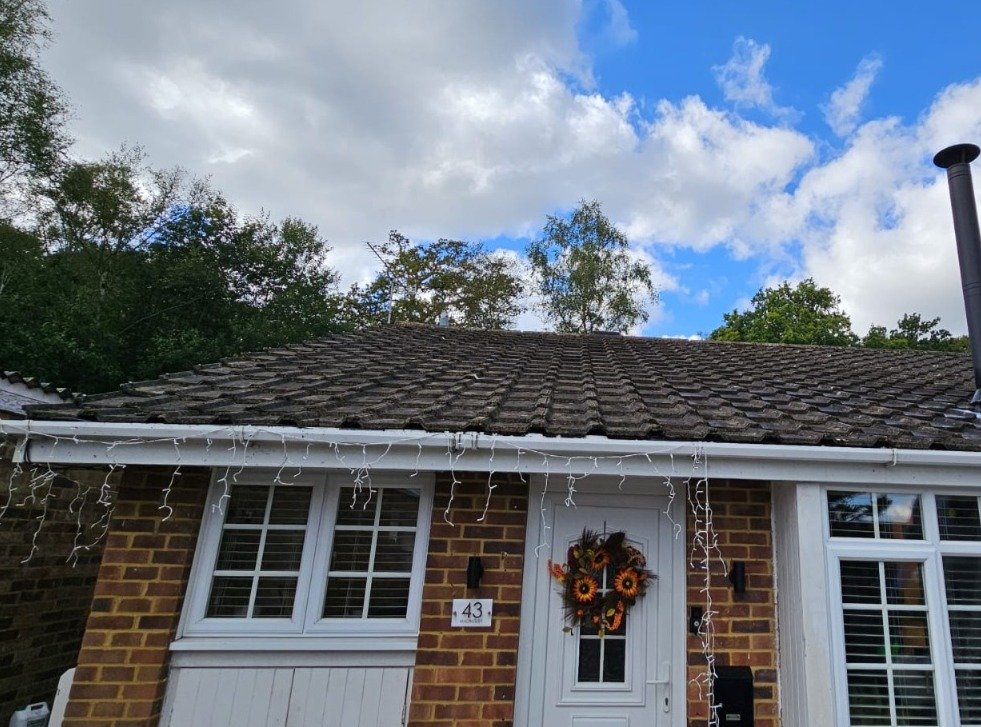
- Bungalows – low gutters are easy to see, so problems get spotted early, but they often sit close to hedges and shrubs and fill quicker than you would expect.
- Three-storey townhouses – debris is hard to see from the ground, so blockages tend to go unnoticed until water runs down the wall.
- Period properties – older homes in places like Henley-on-Thames, Sonning and Caversham may still have cast iron gutters, which rust when water sits in them. Keeping them clear matters even more.
- Houses with valleys or dormers – where two roof slopes meet, debris is channelled into one spot, and that spot blocks first.
- Homes with mossy roofs – heavy moss means gutters refill quickly. Dealing with it through roof cleaning often means the gutters need clearing less often afterwards.
Signs your gutters need attention sooner
Whatever schedule you choose, treat it as a starting point. Gutters do not read calendars, and a stormy autumn can fill them in a matter of weeks. Watch for:
- Water spilling over the front edge when it rains
- Grass, weeds or small plants growing along the gutter line
- Dark streaks or green staining on the wall below
- A downpipe that stays dry while it is raining hard
- Gutters that look like they are sagging or pulling away from the fascia
- Damp patches on an inside wall, particularly upstairs
If you notice any of these, get the gutters looked at rather than waiting for the next planned clean.
What happens if gutters are left too long?
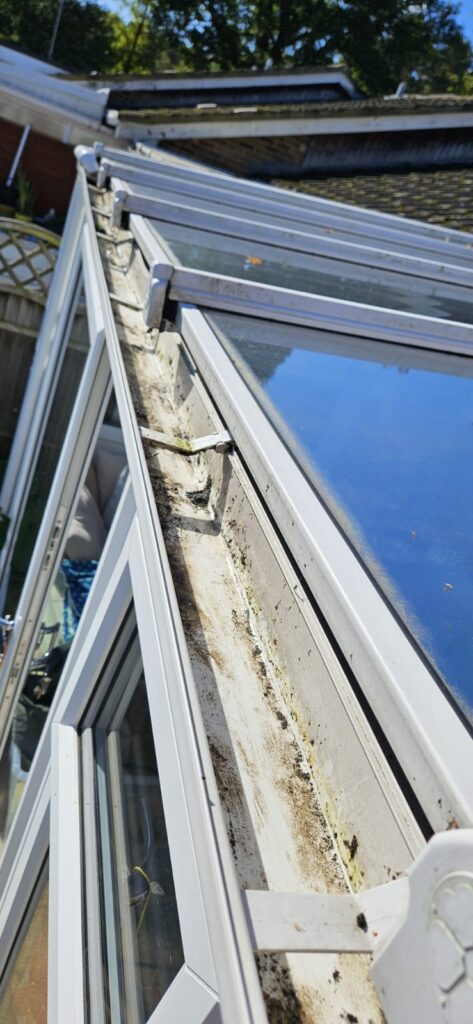
Rainwater has to go somewhere. When a gutter is full, it overflows down the face of the wall or backs up behind the fascia. Over time that can lead to damp walls, rotten fascia boards, stained brickwork or render and water pooling near the foundations. In winter, standing water can freeze and add weight to brackets that are already under strain.
Leaving gutters too long also makes the eventual clean harder. Wet debris compacts into a heavy sludge, and by that stage it has often worked its way into the downpipes as well. Most of this damage builds slowly and quietly, which is exactly why a regular routine is easier and cheaper than repairs later on.
Is it safe to clean gutters yourself?
Some homeowners with single-storey properties are happy to do it themselves. If you do, use a sound ladder on firm, level ground, have someone foot it, never overreach and never climb onto the roof. Wear gloves, as gutter debris can contain sharp fragments and bird droppings. For two- and three-storey homes, conservatories, or anywhere you cannot reach comfortably, it is far safer to leave it to someone with the right equipment.
Our gutter cleaning service uses a high-reach vacuum system operated from the ground, so there are no ladders leaning on your gutters and nobody walking on your roof. We check and clear the downpipes too, and show you camera footage from before and after so you can see exactly what came out.
Need a hand?
If you are unsure what routine suits your home, we are happy to take a look and give you an honest recommendation based on your trees and your house, not a sales pitch. We cover towns across the area, including gutter cleaning in Crowthorne, gutter cleaning in Camberley and gutter cleaning in Henley-on-Thames. Request a free quote online or call us on 01344 578902.
Frequently asked questions
Is once a year enough for gutter cleaning?
For many homes, yes. A single clean in late autumn, after most leaves have fallen, keeps gutters flowing through winter when rainfall is heaviest. If you have overhanging trees, pines nearby or a mossy roof, once a year may not be enough, and a second clean in spring is usually worth it to stop debris building up again.
Do new-build houses need their gutters cleaning?
They do, although usually less often than older homes surrounded by mature trees. New-build gutters still collect moss, grit from tiles, windblown leaves and building debris left over from construction. Checking them within the first couple of years is sensible, and many owners on open estates settle into a clean every one to two years.
What time of year is best for gutter cleaning?
Late autumn is the most useful time for most homes, once the bulk of the leaves have come down, so the gutters are clear for the winter rain. Properties under pine trees or with heavy tree cover often benefit from a second clean in spring to remove needles, seeds and pollen that have gathered over the colder months.
Free, no-obligation quote
Want us to take care of it?
JRH Exterior Solutions is a family-run, fully insured team covering Berkshire, Surrey and Oxfordshire.